
Littmann CORE vs Cardiology IV: Which Stethoscope is Right For You
When it comes to choosing a professional stethoscope, 3M Littmann offers two exceptional options that healthcare professionals trust: the innovative Littmann CORE Digital Stethoscope and the time-tested Cardiology IV. Both represent the pinnacle of acoustic performance, but they serve different needs in modern clinical practice.
Whether you're a cardiologist seeking the finest acoustic detail, a nurse practitioner managing diverse patient populations, or a medical student making your first professional stethoscope investment, understanding the differences between these two models will help you make the right choice for your practice.
Quick Comparison Overview
Littmann CORE Digital Stethoscope

A cutting-edge digital stethoscope that combines traditional acoustic excellence with Bluetooth technology, offering sound amplification up to 40x, active noise cancellation, and the ability to record and share heart and lung sounds through a smartphone app.
Littmann Cardiology IV

A premium acoustic stethoscope featuring a tunable diaphragm on both sides of the chestpiece, delivering exceptional acoustic performance across all patient types without any electronic components or batteries.
Understanding Your Needs: Key Decision Factors
Clinical Environment Considerations
The environment where you practice significantly impacts which stethoscope will serve you best. If you work in noisy emergency departments, busy clinics, or critical care units where ambient noise interferes with auscultation, the CORE's active noise cancellation technology can be invaluable. The digital amplification helps you hear subtle sounds that might otherwise be masked by ventilators, monitors, or hallway traffic.
Conversely, if you practice in quieter clinical settings or prefer the simplicity of traditional auscultation without technology interfaces, the Cardiology IV provides exceptional acoustic clarity without the need for charging, apps, or digital features.

Patient Population
Your typical patient demographics should influence your decision. The CORE excels with challenging auscultation scenarios: patients with obesity, those with lung conditions requiring precise breath sound analysis, pediatric patients who may be fussy or uncooperative during examination, and critical care patients where detecting subtle changes can be life-saving.
The Cardiology IV's dual-sided chestpiece offers versatility across all age groups. The diaphragm side works beautifully for adult and pediatric patients, while the bell mode (activated by lighter pressure) helps detect low-frequency sounds crucial for cardiac assessment across all patient types.
Technology Integration Preferences
Consider how technology fits into your clinical workflow. Do you value the ability to record heart murmurs for consultation with specialists? Would you benefit from visualizing heart sounds as waveforms? Do you want to track patient recordings over time or share auscultation findings with colleagues or patients?
If you answered yes to these questions, the CORE's digital capabilities open new possibilities for patient care, education, and telemedicine applications. However, if you prefer immediate, analog assessment without device management, the Cardiology IV offers pure acoustic performance without batteries or apps to manage.
Detailed Feature Comparison
Acoustic Performance - CORE
Delivers outstanding acoustic clarity with the added benefit of amplification up to 40 times. The digital technology allows you to toggle between amplified and analog modes, giving you flexibility based on your immediate needs. The active noise cancellation reduces ambient sound by up to 85%, helping you focus on the physiological sounds that matter. Frequency response can be adjusted through the companion app, allowing customization for different clinical scenarios.
Acoustic Performance - Cardiology IV
Offers exceptional acoustic sensitivity and performance without amplification. The stainless steel chestpiece and specially designed tunable diaphragm deliver excellent sound transmission across both high and low frequencies. Many clinicians appreciate the immediate, unfiltered acoustic response that allows for nuanced interpretation developed through years of clinical experience.
Build Quality and Durability
Both stethoscopes exemplify Littmann's commitment to quality, but they achieve durability differently.
The CORE features a robust chestpiece designed to house sophisticated electronics while maintaining durability. The sealed components are protected against fluids and daily wear, though like all digital devices, the electronics have a finite lifespan. The rechargeable battery typically lasts around five years with regular use, after which the device can still function in analog mode.
The Cardiology IV represents tried-and-true mechanical engineering with fewer components that can fail. The stainless steel chestpiece resists stains and corrosion. The tubing resists skin oils and alcohol degradation. With proper care, a Cardiology IV can provide decades of reliable service, making it an excellent long-term investment.
Ease of Use and Learning Curve
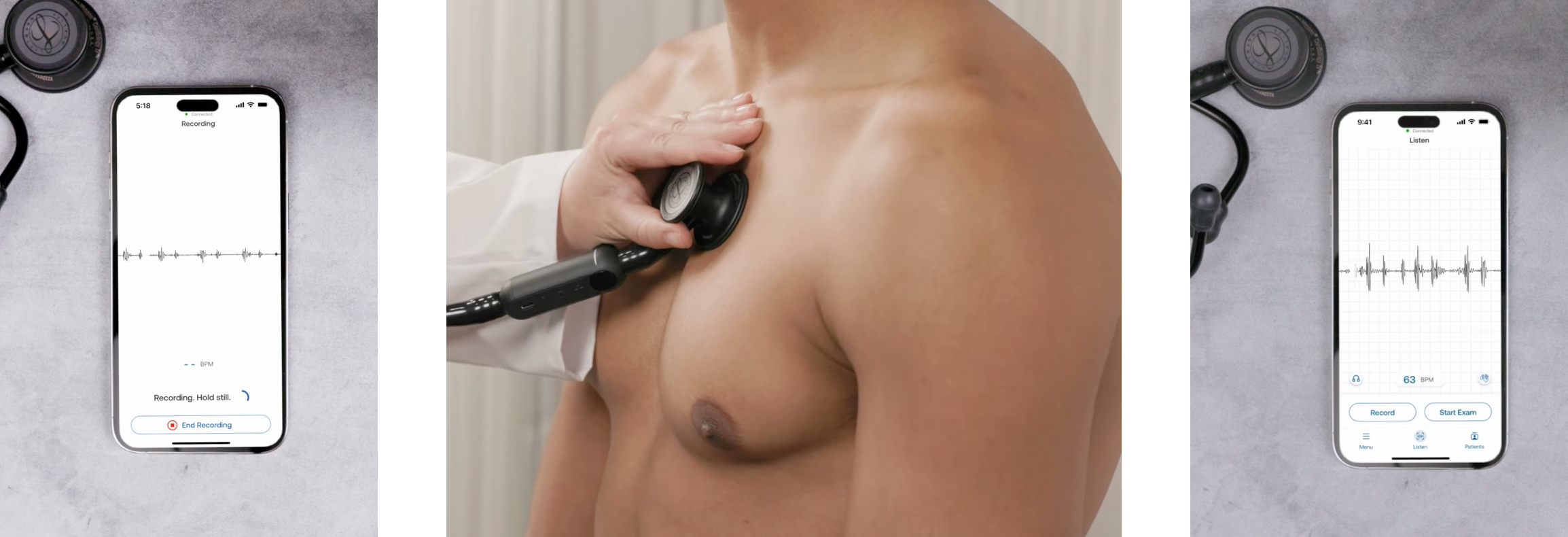
Littmann CORE: Requires initial setup with the Eko smartphone app (iOS or Android), including Bluetooth pairing and familiarization with digital controls. The learning curve is minimal for tech-comfortable users, but some clinicians initially find the app interface adds a step to their workflow. Once configured, however, most users find the interface intuitive. The ability to switch instantly between amplified and analog modes provides flexibility during examinations.
Cardiology IV: Offers immediate use right out of the box with no setup required. The tunable diaphragm technology is straightforward—alternating pressure on the chestpiece toggles between diaphragm and bell modes. This simplicity appeals to clinicians who want to focus entirely on patient assessment without technology management.
.png)
Recording and Documentation Capabilities
This represents perhaps the most significant difference between these models.
The CORE transforms auscultation into a documentable, shareable clinical finding. You can record 15, 30, 60, or 120-second audio clips directly through the app, annotate them with patient information, and store them securely for comparison over time. The waveform visualization helps identify patterns and teaches trainees to recognize specific conditions. Recordings can be shared with specialists for consultation or used for patient education, helping patients understand their conditions through audio playback.
The Cardiology IV provides no recording capabilities, maintaining the traditional approach where auscultation findings are documented through written notes and clinical description. While this lacks the documentation advantages of digital recording, some clinicians prefer this immediate, analog approach that emphasizes clinical judgment over technology.
Portability and Convenience
Littmann CORE: Slightly heavier than the Cardiology IV due to electronics, though still comfortable for all-day wear. Requires periodic charging (battery lasts approximately 3 hours of continuous use or several weeks with typical intermittent clinical use). You'll need to remember to charge it like your other devices, though standby time is excellent. The Bluetooth connection means you'll need your smartphone nearby to access digital features.
Cardiology IV: Completely portable with no batteries, charging cables, or smartphone dependence. It's always ready, works anywhere, and requires no power source. This makes it ideal for long shifts, rural or remote care settings, or situations where device charging isn't convenient.
Specialized Use Cases
Emergency Medicine and Critical Care
Emergency physicians and critical care nurses often work in the noisiest clinical environments where every second counts. The CORE's noise cancellation and amplification can be decisive when trying to hear breath sounds in a busy trauma bay or detecting a subtle pneumothorax in a critically ill patient. The ability to quickly amplify sounds without repositioning the chestpiece saves precious time during urgent assessments.
However, the Cardiology IV's reliability without batteries makes it a dependable backup option in emergency settings where device failures cannot be tolerated. Many emergency departments keep both types available, using the CORE as the primary tool with the Cardiology IV as a reliable backup.

Cardiology and Pulmonology
Specialists who focus on cardiovascular and respiratory conditions often benefit most from the CORE's recording capabilities. The ability to capture a murmur, compare it to previous recordings, and share it with surgical colleagues for intervention planning adds significant clinical value. The waveform visualization can help distinguish subtle differences in timing and quality of heart sounds.
That said, many experienced cardiologists prefer the Cardiology IV for its immediate, unprocessed acoustic feedback that they've learned to interpret over decades of practice. The dual-sided chestpiece with separately optimized diaphragm and bell functions provides the versatility these specialists need.
Primary Care and Family Medicine
Primary care physicians see diverse patient populations across all age groups and conditions. The CORE's versatility across different body types and acoustic challenges makes it valuable for general practice. The recording feature helps when you want to consult with specialists without scheduling an additional cardiology referral for a borderline murmur.
The Cardiology IV's simplicity and reliability appeal to primary care physicians who perform dozens of examinations daily and want a tool that never needs charging or troubleshooting. Its consistent performance across all patient types makes it a dependable workhorse for general practice.
Medical Students and Residents
For learners, both stethoscopes offer distinct educational advantages.
The CORE provides exceptional teaching tools: recording abnormal findings for later review, comparing textbook examples to real patient sounds, building a reference library of conditions encountered during training, and sharing findings with attendings for immediate feedback. The visual waveforms help students understand what they're hearing and develop pattern recognition skills.
The Cardiology IV teaches traditional auscultation skills without technological mediation, helping students develop the clinical acumen that forms the foundation of physical examination. Many programs recommend students start with quality acoustic stethoscopes like the Cardiology IV to develop fundamental skills before adopting digital tools.
Budget is also a consideration for students. While the CORE represents a significant investment, its digital capabilities may reduce the need for additional educational tools. The Cardiology IV's lower price point makes premium acoustic performance more accessible to students, and its durability means it can serve throughout training and well into professional practice.

Telemedicine and Remote Care
Healthcare providers incorporating telemedicine into their practice will find the CORE's recording and sharing capabilities uniquely valuable. You can examine patients in person, record relevant findings, and share them electronically with consulting specialists or document them in the electronic health record. This bridges the gap between in-person assessment and virtual care delivery.
The Cardiology IV serves traditional in-person care excellently but offers no functionality for remote or asynchronous consultation.
Maintenance and Long-Term Ownership
Littmann CORE Maintenance
The CORE requires more active maintenance than its acoustic counterpart. You'll need to keep the device charged, maintain the smartphone app with updates, and eventually replace the battery after approximately five years of regular use. The eartubes and eartips are replaceable, as with any Littmann stethoscope. The electronic components should be cleaned carefully according to manufacturer guidelines—while the chestpiece is sealed against fluids, it shouldn't be soaked or subjected to harsh chemicals. Most standard healthcare disinfectant wipes are appropriate for cleaning between patients.
Cardiology IV Maintenance
Maintenance is straightforward and minimal. Replace eartips as they wear, clean the chestpiece and tubing with alcohol or approved disinfectants, and occasionally check that all connections remain tight. The non-chill rim can be replaced if damaged. With basic care, the Cardiology IV can provide many years of reliable service with no battery replacements or electronics concerns.
Total Cost of Ownership
The CORE has a higher initial purchase price and potential long-term costs including battery replacement after several years and the need for a compatible smartphone with the Eko app. However, the digital features may offset costs in other areas, such as reduced need for cardiology referrals when primary care providers can record and share findings efficiently.
The Cardiology IV offers a lower upfront cost and virtually no ongoing expenses beyond occasional replacement of eartips and perhaps tubing after many years of heavy use. For clinicians seeking the lowest total cost of ownership over decades, the Cardiology IV typically wins this comparison.
Making Your Decision: A Practical Framework
Choose the Littmann CORE if you:
- Work in noisy clinical environments where ambient sound interferes with auscultation
- Value the ability to record and document auscultation findings
- Need amplification for challenging patient populations
- Want to build a reference library of normal and abnormal sounds
- Incorporate telemedicine or remote consultation into your practice
- Teach students or residents and want powerful educational tools
- Are comfortable with technology and device management
- Don't mind periodic charging and app management
- Want visualization tools to supplement acoustic assessment
Choose the Cardiology IV if you:
- Prefer traditional acoustic auscultation without electronic intervention
- Work in quiet to moderate noise environments
- Want maximum durability and long-term reliability
- Don't need recording or amplification features
- Prefer a lower purchase price and minimal ongoing costs
- Want a device that's always ready without charging
- Value simplicity and immediate use without apps or technology
- Have developed strong auscultation skills through traditional methods
- Want a stethoscope that can last decades with minimal maintenance
Frequently Asked Questions
General Comparison Questions
Littmann CORE Specific Questions
Cardiology IV Specific Questions
Technical and Practical Questions
Conclusion: Both Are Excellent Choices
There's no universally "better" stethoscope between the CORE and Cardiology IV—only the better choice for your specific needs, practice environment, and clinical workflow.
The Littmann CORE represents the future of auscultation, combining traditional acoustic excellence with digital innovation that enhances diagnostic capabilities, enables documentation, and supports modern healthcare delivery models including telemedicine. It's the right choice for clinicians who embrace technology and work in challenging acoustic environments or with complex patient populations.
The Littmann Cardiology IV represents the perfection of traditional stethoscope design—exceptional acoustic performance, legendary reliability, and the simplicity that allows clinicians to focus entirely on patient assessment without technology management. It remains the preferred choice for many experienced clinicians who have developed their skills with acoustic stethoscopes and see no need for digital features.
Both stethoscopes will serve you excellently for years to come. Consider your clinical environment, patient population, technology comfort level, and budget to make the choice that best supports your practice.
At SurgoMed, we carry both the Littmann CORE Digital Stethoscope and the Cardiology IV, along with expert staff who can answer your questions and help you select the perfect stethoscope for your clinical needs. Explore our full selection of Littmann stethoscopes and diagnostic equipment to find the tools that will support your practice for years to come.
