The Littmann CORE Digital Stethoscope for Clinicians With Mild-to-Moderate Hearing Loss

Medical Disclaimer
This guide provides general information about using the Littmann CORE with hearing loss. Individual hearing loss patterns vary significantly, and what works for one person may not work for another.
Before making clinical decisions:
- Consult your audiologist about your specific hearing capabilities
- Validate your ability to hear diagnostic sounds in controlled settings
- Work with your institution's occupational health and disability services
- Establish appropriate backup assessment protocols
This information does not replace professional medical or audiological advice. Patient safety must always be the primary consideration.
----------------------------------
For clinicians with hearing impairments, auscultation can present unique challenges, especially in noisy environments or when listening for subtle abnormalities. Whether you are a nurse, physician, paramedic, respiratory therapist, or student, choosing the right stethoscope can significantly impact your diagnostic accuracy and confidence.
The 3M™ Littmann® CORE Digital Stethoscope is one of the most widely recommended stethoscopes for clinicians with mild to moderate hearing loss. With up to 40x amplification, active noise cancellation, and compatibility with various hearing-assistive pathways, the CORE helps clinicians hear more clearly, interpret sounds more confidently, and continue performing high-quality assessments.
This guide explains how the Littmann CORE supports hearing-impaired clinicians, the different ways you can use it with hearing aids or headphones, and the common questions clinicians ask before purchasing.
Important Scope Limitation
This guide focuses on clinicians with mild to moderate hearing loss who retain functional hearing with or without hearing aids.
The Littmann CORE may NOT be appropriate for:
- Severe to profound hearing loss
- Complete deafness in one or both ears
- Clinicians who cannot hear amplified sounds even at maximum volume
If you have severe hearing loss or are deaf: Amplification alone is unlikely to provide adequate support for diagnostic auscultation. You may need alternative assessment methods, visual diagnostic tools (ultrasound, ECG), or specialized accommodations. Consult with your audiologist, occupational health team, and institution's disability services before purchasing.
Critical safety principle: If you cannot reliably hear and interpret heart and lung sounds, even with amplification, do not rely solely on auscultation for clinical decisions. Use alternative assessment methods appropriate for your hearing level.
Why the Littmann CORE Is a Strong Option for Clinicians With Hearing Loss
The Littmann CORE offers several built-in features that directly support clinicians who need increased clarity, volume, or visualization to interpret auscultation findings accurately.
Evidence for Digital Stethoscopes and Hearing Loss
What research shows:
- Digital amplification can improve sound detection for clinicians with mild-to-moderate hearing loss
- Visual waveform displays provide supplementary assessment pathways
- Bluetooth streaming to hearing aids or headphones offers flexible listening options
These findings support the growing role of the electronic stethoscope in accommodating clinicians with mild-to-moderate hearing loss.
Important limitations:
- Limited peer-reviewed research specifically validates digital stethoscopes for hearing-impaired clinicians
- Most studies focus on general populations, not clinicians with documented hearing loss
- Individual hearing loss patterns vary significantly—what works for one person may not work for another
- No standardized protocols exist for validating auscultation competency with amplified stethoscopes
Validation responsibility: Before relying on the CORE clinically, you should:
- Test it in controlled settings with known normal and abnormal findings
- Have a colleague with normal hearing verify your interpretations
- Consult your audiologist about whether your specific hearing loss pattern is compatible with amplified auscultation
- Work with your institution's occupational health or disability services to establish appropriate accommodations
The CORE is a valuable tool, but individual validation is essential for patient safety.
1. Up to 40x Amplification Helps Compensate for Mild Hearing Loss
The CORE’s digital amplifier significantly boosts the volume of:
- Faint murmurs
- Subtle crackles
- Quiet breath sounds
- Soft bowel tones
- Low-frequency cardiac vibrations
This amplification helps clinicians with mild or early-stage hearing impairment hear critical sounds more clearly, without needing specialized assistive equipment.
Understanding Amplification: The "40x" specification refers to maximum technical amplification capacity, not a recommendation to use maximum volume. Most clinicians use moderate amplification levels (3-6 on the app scale). Start low and adjust based on your specific hearing needs—excessive amplification can distort sounds and make interpretation harder.
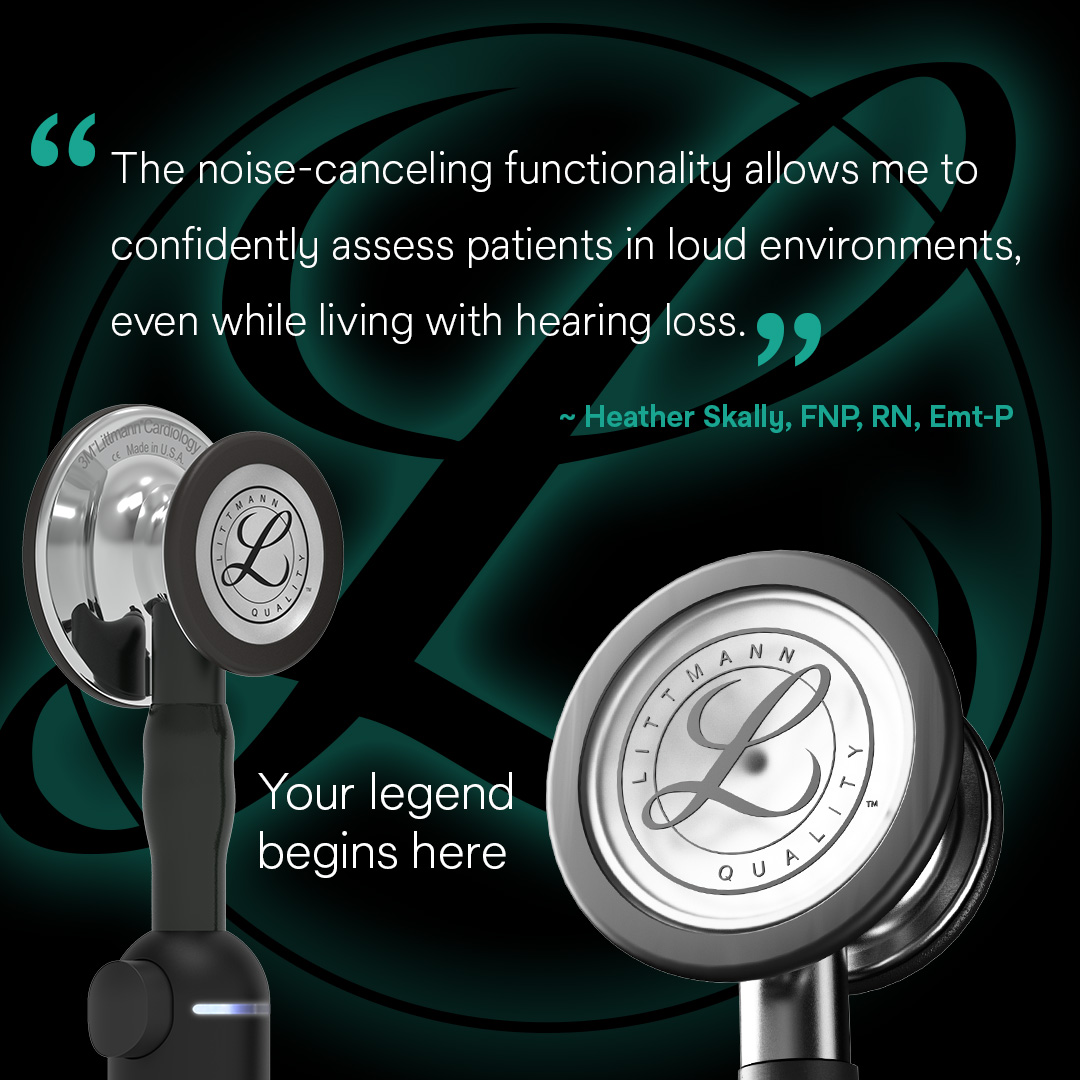
2. Active Noise Cancellation (ANC) Reduces Background Distractions
Hearing loss can make it harder to distinguish signal from noise. The CORE’s ANC filter out:
- Conversations
- Monitor beeps
- Environmental hum
- Hallway noise
- Equipment vibrations
Noise filtering is one of the key advantages of an electronic stethoscope, especially for clinicians who struggle to distinguish signal from background sound. This creates a cleaner listening environment, especially valuable in:
- ICUs
- EDs
- Ambulances
- Med-Surg units
- Pediatric wards
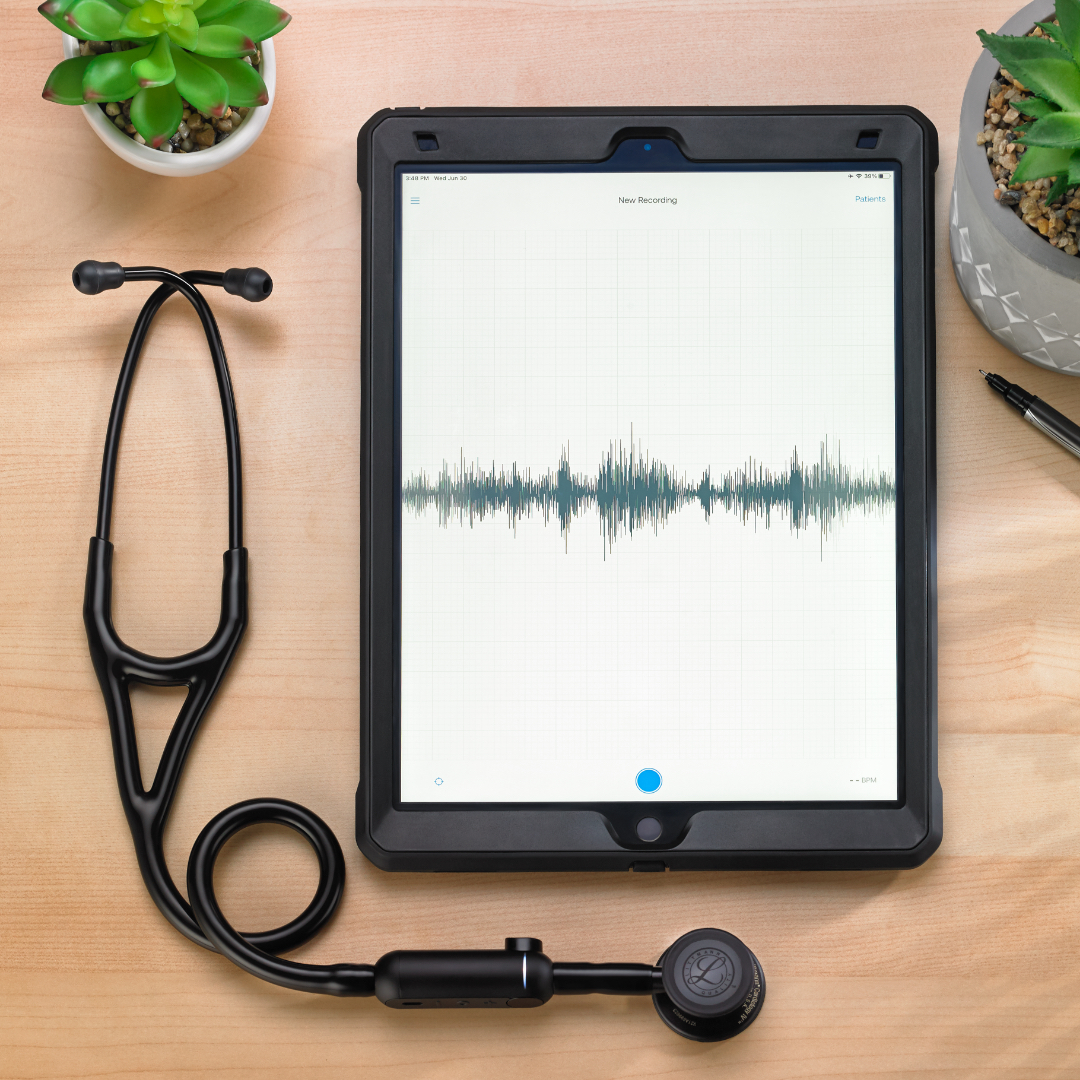
3. Visual Waveform Display Supports Mixed Auditory-Visual Learning
The CORE pairs with the Eko App, which shows a phonocardiogram waveform during auscultation. Visualizing sounds helps clinicians:
- Confirm heart sound timing
- Identify murmurs
- Distinguish abnormalities
- Validate what they’re hearing
This visual support is extremely beneficial for clinicians with hearing challenges. Waveform visualization is a defining feature of a modern digital stethoscope, offering a supplementary pathway beyond auditory interpretation.
4. Compatibility With Hearing Aids, Cochlear Implants & Streaming Devices
The Eko App can stream auscultation sound to:
- Bluetooth-enabled hearing aids
- Cochlear implants
- Bone-anchored hearing devices
- External streaming receivers
This provides more listening options for clinicians with different types of hearing assistive technology.
Will the Littmann CORE Work for Your Hearing Loss?
The CORE is most likely to help if you:
✔ Have mild-to-moderate hearing loss (with or without hearing aids)
✔ Can hear amplified speech clearly in most environments
✔ Successfully use your current stethoscope with difficulty (but not complete inability)
✔ Struggle mainly in noisy environments or with very soft sounds
✔ Have high-frequency hearing loss (consonant sounds) more than low-frequency loss
The CORE is less likely to help if you:
✘ Have severe-to-profound hearing loss
✘ Cannot hear amplified sounds even at maximum volume
✘ Have complete hearing loss in your better ear
✘ Cannot distinguish different sound frequencies even when loud
✘ Rely entirely on visual communication (ASL, lipreading)
Decision recommendation:
- Consult your audiologist before purchasing
- Request a trial or demo if possible (some medical suppliers offer this)
- Have a backup assessment plan if amplified auscultation proves insufficient
- Consider complementary diagnostic tools (ultrasound, ECG) for your practice
Ways Clinicians With Hearing Impairments Can Use the Littmann CORE
Based on Littmann + Eko published guidance, there are three recommended listening setups for clinicians with hearing loss.
Option 1: Use Amplification Through the Stethoscope Earpieces (Best for Mild Hearing Loss)
If you have mild hearing impairment, using the stethoscope normally, with amplified mode on, is often enough.
How to use this method:
- Insert the stethoscope eartips directly into your ear canals
- Use soft-seal eartips for better low-frequency transmission
- Increase amplification to your preferred level
This is the simplest and most direct option for clinicians who need enhanced clarity without additional devices.
Option 2: Stream Sounds Through Over-the-Ear Headphones (Compatible with Most Hearing Aids)
If you cannot stream directly into your hearing aids, you can route sound through high-quality wired, over-the-ear headphones.
How to use this setup:
- Plug wired headphones into the phone’s audio jack.
- Pair your Littmann CORE with the Eko App.
- In the Eko App settings, turn ON Wireless Listening (Play From Headphones).
- Wear your hearing aids under or inside the headphones as needed.
This method provides strong, clear sound reproduction and is widely used by clinicians with moderate hearing impairments.
Option 3: Bluetooth Streaming to Hearing Aids (Advanced - Requires Validation)
How it theoretically works:
- Your hearing aids connect to your phone via Bluetooth
- The Eko App streams auscultation audio to your phone
- Enable "Play From Headphones" in Eko App settings
- Audio routes to your hearing aids through phone connectivity
CRITICAL LIMITATIONS - READ CAREFULLY:
❌ Most hearing aids are NOT designed for diagnostic auscultation
- Hearing aids optimize for speech frequencies (500-4000 Hz)
- Heart and lung sounds include important frequencies outside this range
- Low-frequency cardiac sounds (S3, S4) may be filtered out entirely
- High-frequency crackles may be distorted or lost
❌ Sound processing delays may alter timing
- Bluetooth introduces latency (delay between chest piece and your hearing)
- This can affect your ability to identify heart sound timing and murmur characteristics
- Critical for distinguishing systolic vs. diastolic events
❌ Compression and noise reduction algorithms interfere
- Hearing aids compress loud sounds and amplify soft sounds (designed for speech)
- This processing alters the natural character of heart and lung sounds
- May mask important diagnostic features
BEFORE using this method clinically:
- Mandatory audiologist consultation - Have your audiologist:
- Test your hearing aids' frequency response across diagnostic ranges
- Verify Bluetooth audio quality with test sounds
- Document whether your devices are appropriate for clinical use
- Validation testing with known findings:
- Practice with colleagues who have documented normal and abnormal sounds
- Have someone with normal hearing verify your interpretations
- Test in multiple clinical scenarios before relying on this method
- Institutional approval:
- Discuss with occupational health or disability services
- Document your accommodation and validation process
- Establish backup assessment protocols
Honest assessment: While some clinicians successfully use hearing aid streaming, it's unreliable for many users due to device limitations. Wired over-ear headphones (Option 2) are generally more dependable for diagnostic auscultation.
Why the Littmann CORE Improves Confidence for Clinicians With Hearing Challenges
Clinicians consistently report improved:
- Ability to detect subtle sounds
- Confidence in noisy environments
- Accuracy in identifying abnormalities
- Ease of distinguishing crackles vs wheezes vs rhonchi
- Reduced listening fatigue during long shifts
For professionals with hearing loss, amplification and digital clarity can be transformative. 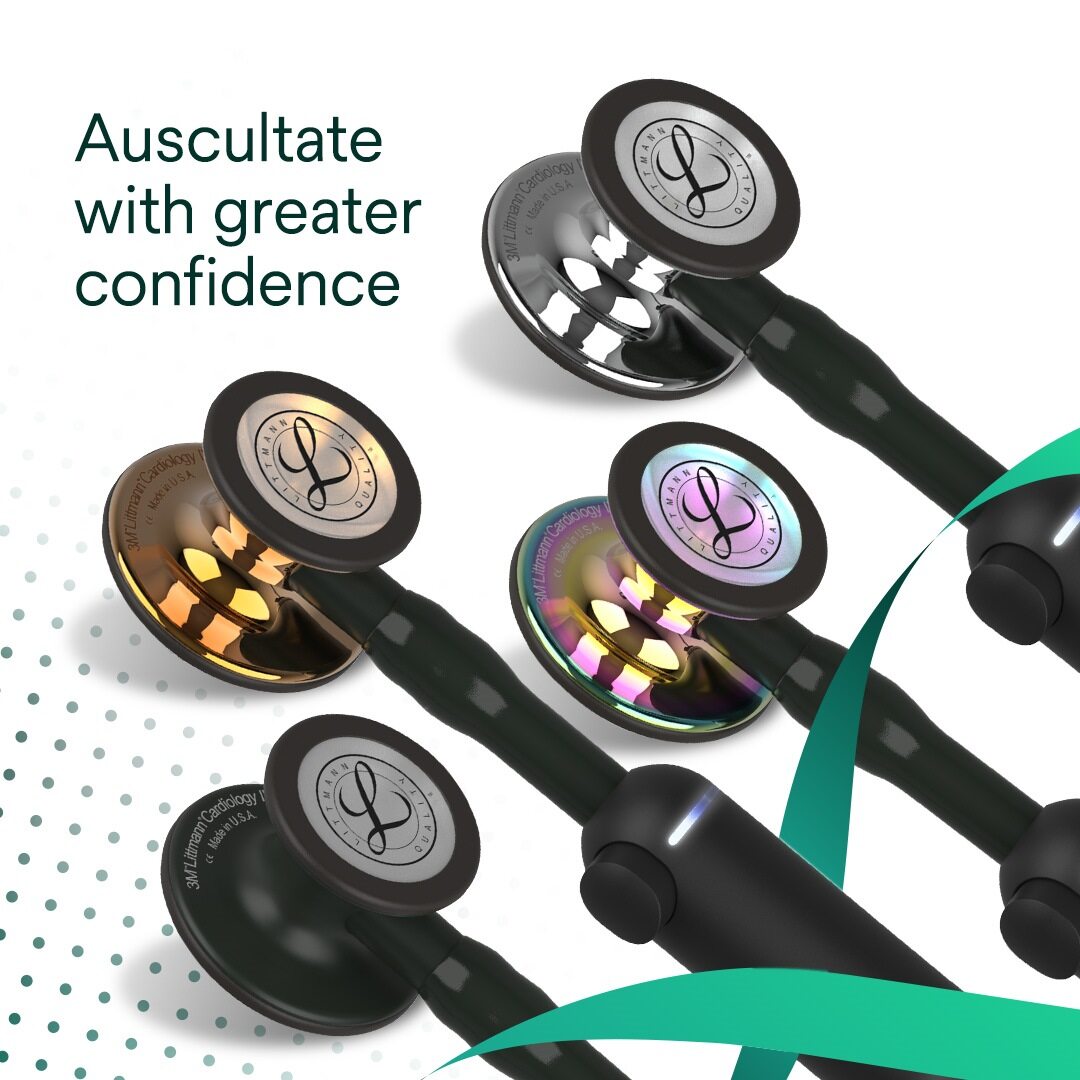
Beyond Stethoscopes: Complementary Assessment Strategies
For clinicians with hearing loss, relying solely on auscultation may not be safe or appropriate. Consider these complementary approaches:
Point-of-care tools:
- Handheld ultrasound - Visual assessment of cardiac function, lung pathology
- Pulse oximetry - Objective respiratory status monitoring
- ECG - Cardiac rhythm and electrical activity assessment
- Capnography - Respiratory status in acute settings
Clinical assessment techniques:
- Tactile fremitus and chest expansion assessment
- Visual observation (respiratory effort, cyanosis, work of breathing)
- Patient symptom reporting and history
- Vital sign trends over time
Team-based approaches:
- Partner with colleagues for auscultation verification when critical
- Document when findings are difficult to assess
- Communicate limitations clearly to supervising physicians
- Use your clinical judgment about when specialist input is needed
Educational resources:
- National Deaf Center (for healthcare professionals)
- Association of Medical Professionals with Hearing Losses (AMPHL)
- Your institution's disability services office
Remember: Good clinical practice involves using multiple assessment modalities. Hearing loss may actually make you a more thorough clinician by encouraging comprehensive evaluation beyond auscultation alone.
Frequently Asked Questions for Clinicians With Hearing Loss
Can the Littmann CORE pair directly with hearing aids?
No. The CORE cannot pair directly with hearing aids or cochlear implants. Audio must route through your smartphone using the Eko App, then to hearing aids via your phone's Bluetooth connection.
*Important caveat: Most hearing aids are NOT designed for diagnostic auscultation frequencies. Before relying on this method, you MUST have your audiologist validate that your specific hearing aids can accurately reproduce heart and lung sounds across the necessary frequency ranges (roughly 20-2000 Hz). Many hearing aids filter out critical low-frequency cardiac sounds.
Does the Littmann CORE support wired or over-the-ear headphones?
Yes, and this is often the MOST RELIABLE option for clinicians with hearing loss.
How to use:
- Connect quality wired headphones to your phone's audio jack (may need adapter for newer phones)
- Pair CORE with Eko App
- Enable "Play From Headphones" in app settings
- Keep hearing aids in under/inside headphones if needed
Why this works better than hearing aid streaming:
- No Bluetooth latency issues
- Headphones reproduce full frequency range
- No hearing aid processing interference
- More consistent sound quality
Can I use the stethoscope normally if I have mild hearing loss?
It depends on your specific hearing loss pattern and severity. Many clinicians with mild loss can use the CORE's earpieces with amplification and achieve adequate clarity. However:
- You should validate this in controlled settings first
- Test with known normal and abnormal findings
- Have colleagues verify your interpretations initially
- Consider your specific frequencies of hearing loss (high vs. low frequency loss affects different sounds)
Don't assume amplification alone is sufficient—validate your ability to hear critical diagnostic features before relying on this method clinically.
What features make the CORE helpful for hearing-impaired clinicians?
Three main features:
- Amplification - Makes sounds louder (though this doesn't solve all hearing loss challenges)
- Visual waveforms - Provides visual confirmation of timing and patterns
- Flexible audio routing - Works with headphones, and potentially hearing aids if validated
Most important feature: Visual waveform display, as it provides an alternative assessment pathway that doesn't rely on hearing alone.
Can the Littmann CORE help compensate for low-frequency hearing loss?
Partially, but with limitations. Amplification can boost low-frequency sounds (S3, S4, diastolic murmurs), but:
- If you cannot distinguish low frequencies even when amplified, you still won't interpret them correctly
- Low-frequency hearing loss may be particularly challenging for cardiac auscultation
- Visual waveforms can help confirm what you're hearing
Consult your audiologist about whether your specific hearing loss pattern makes cardiac auscultation feasible, even with amplification.
Is the CORE useful for teaching or learning with hearing loss?
Yes, with important caveats:
Valuable features for learning:
- Recording capability lets you replay sounds multiple times
- Visual waveforms provide concrete reference points
- Can share recordings with instructors for verification
Limitations:
- You're still learning through your hearing loss—may miss subtle nuances
- Need experienced clinicians to verify your interpretations
- May require additional accommodations in clinical training
Recommendation: Combine the CORE with other learning methods (point-of-care ultrasound, visual assessment, ECG interpretation) to build comprehensive diagnostic skills.
Additional Resources for Clinicians With Hearing Loss
- National Deaf Center - Healthcare career resources and accommodations guidance https://nationaldeafcenter.org
- Association of Medical Professionals with Hearing Losses (AMPHL) Support network and practice resources
- Your institution's disability services office Can help with reasonable accommodations and validation protocols
- Audiology consultation Essential for validating hearing aid compatibility and frequency response
Know your rights: The Americans with Disabilities Act (ADA) requires reasonable accommodations for healthcare professionals with disabilities, including hearing loss. Work with your employer to establish appropriate assessment protocols that ensure both your success and patient safety.


Medical Disclaimer
This guide provides general information about using the Littmann CORE with hearing loss. Individual hearing loss patterns vary significantly, and what works for one person may not work for another.
Before making clinical decisions:
- Consult your audiologist about your specific hearing capabilities
- Validate your ability to hear diagnostic sounds in controlled settings
- Work with your institution's occupational health and disability services
- Establish appropriate backup assessment protocols
This information does not replace professional medical or audiological advice. Patient safety must always be the primary consideration.
----------------------------------
For clinicians with hearing impairments, auscultation can present unique challenges, especially in noisy environments or when listening for subtle abnormalities. Whether you are a nurse, physician, paramedic, respiratory therapist, or student, choosing the right stethoscope can significantly impact your diagnostic accuracy and confidence.
The 3M™ Littmann® CORE Digital Stethoscope is one of the most widely recommended stethoscopes for clinicians with mild to moderate hearing loss. With up to 40x amplification, active noise cancellation, and compatibility with various hearing-assistive pathways, the CORE helps clinicians hear more clearly, interpret sounds more confidently, and continue performing high-quality assessments.
This guide explains how the Littmann CORE supports hearing-impaired clinicians, the different ways you can use it with hearing aids or headphones, and the common questions clinicians ask before purchasing.
Important Scope Limitation
This guide focuses on clinicians with mild to moderate hearing loss who retain functional hearing with or without hearing aids.
The Littmann CORE may NOT be appropriate for:
- Severe to profound hearing loss
- Complete deafness in one or both ears
- Clinicians who cannot hear amplified sounds even at maximum volume
If you have severe hearing loss or are deaf: Amplification alone is unlikely to provide adequate support for diagnostic auscultation. You may need alternative assessment methods, visual diagnostic tools (ultrasound, ECG), or specialized accommodations. Consult with your audiologist, occupational health team, and institution's disability services before purchasing.
Critical safety principle: If you cannot reliably hear and interpret heart and lung sounds, even with amplification, do not rely solely on auscultation for clinical decisions. Use alternative assessment methods appropriate for your hearing level.
Why the Littmann CORE Is a Strong Option for Clinicians With Hearing Loss
The Littmann CORE offers several built-in features that directly support clinicians who need increased clarity, volume, or visualization to interpret auscultation findings accurately.
Evidence for Digital Stethoscopes and Hearing Loss
What research shows:
- Digital amplification can improve sound detection for clinicians with mild-to-moderate hearing loss
- Visual waveform displays provide supplementary assessment pathways
- Bluetooth streaming to hearing aids or headphones offers flexible listening options
These findings support the growing role of the electronic stethoscope in accommodating clinicians with mild-to-moderate hearing loss.
Important limitations:
- Limited peer-reviewed research specifically validates digital stethoscopes for hearing-impaired clinicians
- Most studies focus on general populations, not clinicians with documented hearing loss
- Individual hearing loss patterns vary significantly—what works for one person may not work for another
- No standardized protocols exist for validating auscultation competency with amplified stethoscopes
Validation responsibility: Before relying on the CORE clinically, you should:
- Test it in controlled settings with known normal and abnormal findings
- Have a colleague with normal hearing verify your interpretations
- Consult your audiologist about whether your specific hearing loss pattern is compatible with amplified auscultation
- Work with your institution's occupational health or disability services to establish appropriate accommodations
The CORE is a valuable tool, but individual validation is essential for patient safety.
1. Up to 40x Amplification Helps Compensate for Mild Hearing Loss
The CORE’s digital amplifier significantly boosts the volume of:
- Faint murmurs
- Subtle crackles
- Quiet breath sounds
- Soft bowel tones
- Low-frequency cardiac vibrations
This amplification helps clinicians with mild or early-stage hearing impairment hear critical sounds more clearly, without needing specialized assistive equipment.
Understanding Amplification: The "40x" specification refers to maximum technical amplification capacity, not a recommendation to use maximum volume. Most clinicians use moderate amplification levels (3-6 on the app scale). Start low and adjust based on your specific hearing needs—excessive amplification can distort sounds and make interpretation harder.
2. Active Noise Cancellation (ANC) Reduces Background Distractions
Hearing loss can make it harder to distinguish signal from noise. The CORE’s ANC filter out:
- Conversations
- Monitor beeps
- Environmental hum
- Hallway noise
- Equipment vibrations
Noise filtering is one of the key advantages of an electronic stethoscope, especially for clinicians who struggle to distinguish signal from background sound. This creates a cleaner listening environment, especially valuable in:
- ICUs
- EDs
- Ambulances
- Med-Surg units
- Pediatric wards
3. Visual Waveform Display Supports Mixed Auditory-Visual Learning
The CORE pairs with the Eko App, which shows a phonocardiogram waveform during auscultation. Visualizing sounds helps clinicians:
- Confirm heart sound timing
- Identify murmurs
- Distinguish abnormalities
- Validate what they’re hearing
This visual support is extremely beneficial for clinicians with hearing challenges. Waveform visualization is a defining feature of a modern digital stethoscope, offering a supplementary pathway beyond auditory interpretation.
4. Compatibility With Hearing Aids, Cochlear Implants & Streaming Devices
The Eko App can stream auscultation sound to:
- Bluetooth-enabled hearing aids
- Cochlear implants
- Bone-anchored hearing devices
- External streaming receivers
This provides more listening options for clinicians with different types of hearing assistive technology.
Will the Littmann CORE Work for Your Hearing Loss?
The CORE is most likely to help if you:
✔ Have mild-to-moderate hearing loss (with or without hearing aids)
✔ Can hear amplified speech clearly in most environments
✔ Successfully use your current stethoscope with difficulty (but not complete inability)
✔ Struggle mainly in noisy environments or with very soft sounds
✔ Have high-frequency hearing loss (consonant sounds) more than low-frequency loss
The CORE is less likely to help if you:
✘ Have severe-to-profound hearing loss
✘ Cannot hear amplified sounds even at maximum volume
✘ Have complete hearing loss in your better ear
✘ Cannot distinguish different sound frequencies even when loud
✘ Rely entirely on visual communication (ASL, lipreading)
Decision recommendation:
- Consult your audiologist before purchasing
- Request a trial or demo if possible (some medical suppliers offer this)
- Have a backup assessment plan if amplified auscultation proves insufficient
- Consider complementary diagnostic tools (ultrasound, ECG) for your practice
Ways Clinicians With Hearing Impairments Can Use the Littmann CORE
Based on Littmann + Eko published guidance, there are three recommended listening setups for clinicians with hearing loss.
Option 1: Use Amplification Through the Stethoscope Earpieces (Best for Mild Hearing Loss)
If you have mild hearing impairment, using the stethoscope normally, with amplified mode on, is often enough.
How to use this method:
- Insert the stethoscope eartips directly into your ear canals
- Use soft-seal eartips for better low-frequency transmission
- Increase amplification to your preferred level
This is the simplest and most direct option for clinicians who need enhanced clarity without additional devices.
Option 2: Stream Sounds Through Over-the-Ear Headphones (Compatible with Most Hearing Aids)
If you cannot stream directly into your hearing aids, you can route sound through high-quality wired, over-the-ear headphones.
How to use this setup:
- Plug wired headphones into the phone’s audio jack.
- Pair your Littmann CORE with the Eko App.
- In the Eko App settings, turn ON Wireless Listening (Play From Headphones).
- Wear your hearing aids under or inside the headphones as needed.
This method provides strong, clear sound reproduction and is widely used by clinicians with moderate hearing impairments.
Option 3: Bluetooth Streaming to Hearing Aids (Advanced - Requires Validation)
How it theoretically works:
- Your hearing aids connect to your phone via Bluetooth
- The Eko App streams auscultation audio to your phone
- Enable "Play From Headphones" in Eko App settings
- Audio routes to your hearing aids through phone connectivity
CRITICAL LIMITATIONS - READ CAREFULLY:
❌ Most hearing aids are NOT designed for diagnostic auscultation
- Hearing aids optimize for speech frequencies (500-4000 Hz)
- Heart and lung sounds include important frequencies outside this range
- Low-frequency cardiac sounds (S3, S4) may be filtered out entirely
- High-frequency crackles may be distorted or lost
❌ Sound processing delays may alter timing
- Bluetooth introduces latency (delay between chest piece and your hearing)
- This can affect your ability to identify heart sound timing and murmur characteristics
- Critical for distinguishing systolic vs. diastolic events
❌ Compression and noise reduction algorithms interfere
- Hearing aids compress loud sounds and amplify soft sounds (designed for speech)
- This processing alters the natural character of heart and lung sounds
- May mask important diagnostic features
BEFORE using this method clinically:
- Mandatory audiologist consultation - Have your audiologist:
- Test your hearing aids' frequency response across diagnostic ranges
- Verify Bluetooth audio quality with test sounds
- Document whether your devices are appropriate for clinical use
- Validation testing with known findings:
- Practice with colleagues who have documented normal and abnormal sounds
- Have someone with normal hearing verify your interpretations
- Test in multiple clinical scenarios before relying on this method
- Institutional approval:
- Discuss with occupational health or disability services
- Document your accommodation and validation process
- Establish backup assessment protocols
Honest assessment: While some clinicians successfully use hearing aid streaming, it's unreliable for many users due to device limitations. Wired over-ear headphones (Option 2) are generally more dependable for diagnostic auscultation.
Why the Littmann CORE Improves Confidence for Clinicians With Hearing Challenges
Clinicians consistently report improved:
- Ability to detect subtle sounds
- Confidence in noisy environments
- Accuracy in identifying abnormalities
- Ease of distinguishing crackles vs wheezes vs rhonchi
- Reduced listening fatigue during long shifts
For professionals with hearing loss, amplification and digital clarity can be transformative.
Beyond Stethoscopes: Complementary Assessment Strategies
For clinicians with hearing loss, relying solely on auscultation may not be safe or appropriate. Consider these complementary approaches:
Point-of-care tools:
- Handheld ultrasound - Visual assessment of cardiac function, lung pathology
- Pulse oximetry - Objective respiratory status monitoring
- ECG - Cardiac rhythm and electrical activity assessment
- Capnography - Respiratory status in acute settings
Clinical assessment techniques:
- Tactile fremitus and chest expansion assessment
- Visual observation (respiratory effort, cyanosis, work of breathing)
- Patient symptom reporting and history
- Vital sign trends over time
Team-based approaches:
- Partner with colleagues for auscultation verification when critical
- Document when findings are difficult to assess
- Communicate limitations clearly to supervising physicians
- Use your clinical judgment about when specialist input is needed
Educational resources:
- National Deaf Center (for healthcare professionals)
- Association of Medical Professionals with Hearing Losses (AMPHL)
- Your institution's disability services office
Remember: Good clinical practice involves using multiple assessment modalities. Hearing loss may actually make you a more thorough clinician by encouraging comprehensive evaluation beyond auscultation alone.
Frequently Asked Questions for Clinicians With Hearing Loss
Can the Littmann CORE pair directly with hearing aids?
No. The CORE cannot pair directly with hearing aids or cochlear implants. Audio must route through your smartphone using the Eko App, then to hearing aids via your phone's Bluetooth connection.
*Important caveat: Most hearing aids are NOT designed for diagnostic auscultation frequencies. Before relying on this method, you MUST have your audiologist validate that your specific hearing aids can accurately reproduce heart and lung sounds across the necessary frequency ranges (roughly 20-2000 Hz). Many hearing aids filter out critical low-frequency cardiac sounds.
Does the Littmann CORE support wired or over-the-ear headphones?
Yes, and this is often the MOST RELIABLE option for clinicians with hearing loss.
How to use:
- Connect quality wired headphones to your phone's audio jack (may need adapter for newer phones)
- Pair CORE with Eko App
- Enable "Play From Headphones" in app settings
- Keep hearing aids in under/inside headphones if needed
Why this works better than hearing aid streaming:
- No Bluetooth latency issues
- Headphones reproduce full frequency range
- No hearing aid processing interference
- More consistent sound quality
Can I use the stethoscope normally if I have mild hearing loss?
It depends on your specific hearing loss pattern and severity. Many clinicians with mild loss can use the CORE's earpieces with amplification and achieve adequate clarity. However:
- You should validate this in controlled settings first
- Test with known normal and abnormal findings
- Have colleagues verify your interpretations initially
- Consider your specific frequencies of hearing loss (high vs. low frequency loss affects different sounds)
Don't assume amplification alone is sufficient—validate your ability to hear critical diagnostic features before relying on this method clinically.
What features make the CORE helpful for hearing-impaired clinicians?
Three main features:
- Amplification - Makes sounds louder (though this doesn't solve all hearing loss challenges)
- Visual waveforms - Provides visual confirmation of timing and patterns
- Flexible audio routing - Works with headphones, and potentially hearing aids if validated
Most important feature: Visual waveform display, as it provides an alternative assessment pathway that doesn't rely on hearing alone.
Can the Littmann CORE help compensate for low-frequency hearing loss?
Partially, but with limitations. Amplification can boost low-frequency sounds (S3, S4, diastolic murmurs), but:
- If you cannot distinguish low frequencies even when amplified, you still won't interpret them correctly
- Low-frequency hearing loss may be particularly challenging for cardiac auscultation
- Visual waveforms can help confirm what you're hearing
Consult your audiologist about whether your specific hearing loss pattern makes cardiac auscultation feasible, even with amplification.
Is the CORE useful for teaching or learning with hearing loss?
Yes, with important caveats:
Valuable features for learning:
- Recording capability lets you replay sounds multiple times
- Visual waveforms provide concrete reference points
- Can share recordings with instructors for verification
Limitations:
- You're still learning through your hearing loss—may miss subtle nuances
- Need experienced clinicians to verify your interpretations
- May require additional accommodations in clinical training
Recommendation: Combine the CORE with other learning methods (point-of-care ultrasound, visual assessment, ECG interpretation) to build comprehensive diagnostic skills.
Additional Resources for Clinicians With Hearing Loss
- National Deaf Center - Healthcare career resources and accommodations guidance https://nationaldeafcenter.org
- Association of Medical Professionals with Hearing Losses (AMPHL) Support network and practice resources
- Your institution's disability services office Can help with reasonable accommodations and validation protocols
- Audiology consultation Essential for validating hearing aid compatibility and frequency response
Know your rights: The Americans with Disabilities Act (ADA) requires reasonable accommodations for healthcare professionals with disabilities, including hearing loss. Work with your employer to establish appropriate assessment protocols that ensure both your success and patient safety.
